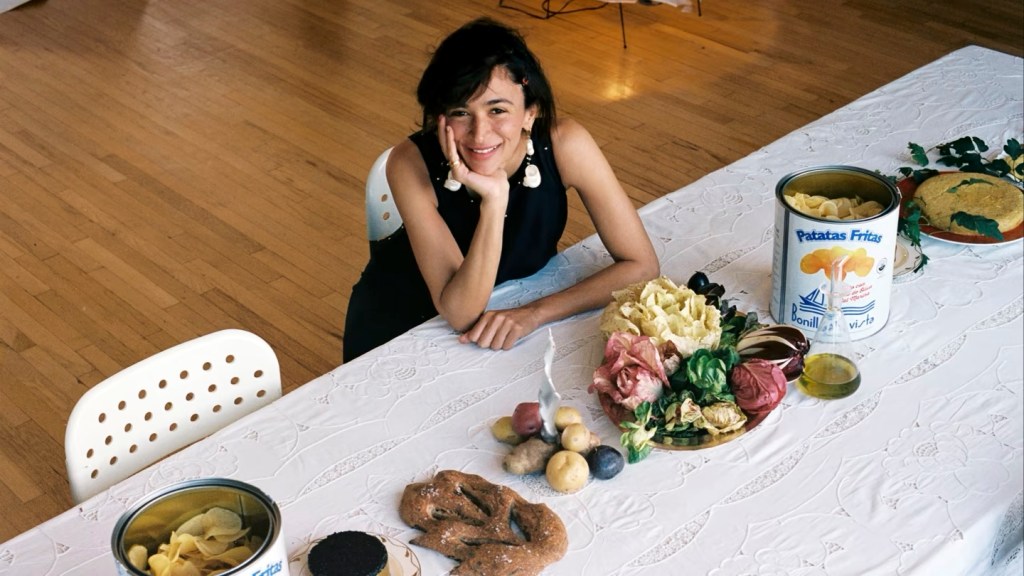
For centuries food and art have existed as separate mediums of cultural expression, one for voyeurism and one for consumption. However, with the advent of social media food has become an aspirational expression of self, enshrined in the hashtags of foodporn and manicured photographs. But, in the wake of over a year of both physical and emotional isolation and the subsequent digitization of much of people’s lives, people are now searching for embodied physical experiences. Now, an emerging category of artists are combining the two, creating interactive edible experiences that encourage presence, physicality and interaction.
New York based artist Laila Gohar explores this intersection in her practice, forming immersive edible landscapes that investigate food both as an artform and as a tool of communication. Part chef, part artist, part set designer, Gohar’s whimsical food-based assemblages’ riot against the increasing digitisation of the contemporary era; their ephemerality asserting their position in the physical realm.
Generally commissioned in conjunction with a brand or an event, Gohar’s instillations blur the boundaries between set design, fine dining and art. Her instillations reject the categorizations inherent to the cannons of art and social media, symbiotically assuming the position of muse, icebreaker and sustenance. Through their synergetic nature, these instillations become inherently anthropological; works that investigate how food can animate and move people.
Gohar’s emphasis on collaboration between the audience and artworks is highlighted in her 2020 instillation the 24hr. Kitchen, a work produced in collaboration with Samsung and Design Studio 2×4. The 24hr. Kitchen was commissioned for the Restaurant and Bar design awards in Milan and investigates the inherent creativity of the kitchen through a temporal body of installations. Segmented into the three sequential blocks of morning, afternoon and night-time, this installation reinterprets the linear methodology of peoples eating. Focusing on three categories: Wheat, Tomato and Sugar, this installation reimagines the boundaries of food and display. It’s playful interpretation of wheat, tomatoes and sugar teeters on the edge of surrealism; including hands and faces sculpted from butter, clusters of tomatoes suspended from the ceiling and Jenga-style mountains of caramel.
Curated on one sinuous weave of table, the installation encourages viewers to walk with the art, tasting and touching as they travel throughout the display. Consuming the artworks before they decay is essential to Gohar’s practice; this ephemerality subverts the traditional concept of artists needing to leave their mark. Although as noted in Ligaya Mishan’s article These Artists Are Creating Work That’s About, and Made From, Food, Gohar worries that “she’s contributing to the proliferation of interactive food experiences that favour a manufactured “moment” over contemplation”. When observing Gohar’s tagged posts on Instagram, it is clear why she worries that her works are being sensationalised- her avantgarde constructions lend themselves to a reaction of awe and amazement. However, at their core, these works reject the sensationalism of the digital realm, their ephemerality and focus on engagement grounding them in the physical realm.
Their inherent tactility questions the digitisation that affords itself to contemporary art and in an era where Netflix replaces the cinema, zoom substitutes the office and trading NFT’s replaces selling physical artworks; Gohar’s inherently physical artworks are refreshing and grounding.
But Gohar is not alone in this field, in Melbourne after the rolling waves of lockdowns that defined 2020 and continue to punctuate 2021, young creatives have turned to the medium of food to combat loneliness and artistic stagnation. Chefs such as Ellie Bouhadana from Ellie’s Table, Sophie McIntyre from the Supper Club and Melbourne collective Long Prawn are redefining the boundaries of art with their immersive edible experiences.
The collective Long Prawn specifically is focusing on the intersection of art and food, with their most recent event Degustation Discordia (2) SPUD LOVE uniting the cooking of Australian Filipino chef Ross Magnaye with the art of performance artist Georgia Rae Banks and painter Simon Fitzsimons in a survey of the potato. Organic and unpolished like the potato, the event was a holistic and seamless exploration of art, food and community.
Similarly, to Gohar’s artworks, Long Prawn creates fleeting works situated in the present; artworks that position you both as the object and the observer and interweave your senses, your emotions and your character. The ephemerality of food-based artworks counteracts the typologies of social media and High Art, because unlike a painting or a photograph on Instagram, food-based experiences are fundamentally impermanent.
In addition to rejecting the digitisation of society, food art positions itself as a more welcoming and engaging approach to art through its focus on shared experiences. As someone who has worked and socialised within the Melbourne art scene and witnessed the unattainable nature of some galleries and exhibitions, I believe that food-art creates a space within the art sector for those who are not already immersed. Food is a universal material, one that does not need a degree in visual arts or curation to be engaged with, and in an era where isolation and social disenfranchisement is at its highest, why not open doors for engagement and enjoyment?
In my recent Podcast Art, Food and The Internet: An interview with Supper Club Founder Sophie McIntyre, I discuss the role of food as an instigator of connections more deeply with the founder of the upcoming Supper Club, Sophie McIntyre. If you are interested in learning more and hearing from a professional in the field, click the button below.
 LILY BEAMISH
Leave a comment